.png "Copy of FY24-848651_COMPD Canva templates book launches_1920by1080 (1920 x 600 px) - 4")

.

- Field Guide French
- TADAT Talks
- Field Guide Eng
What is TADAT
It is an integrated monitoring framework that measures performance of a country’s tax administration at a point in time. This framework is focused on the 9 key performance outcome areas (POAs) that cover most tax administration functions processses and institutions.
The 9 key performance outcome areas (POAs) are assessed on 35 high-level indicators, each built on 1 to 5 dimensions adding up to 61 measurement dimensions, making TADAT a comprehensive but administrable diagnostic tool.
The TADAT Famework
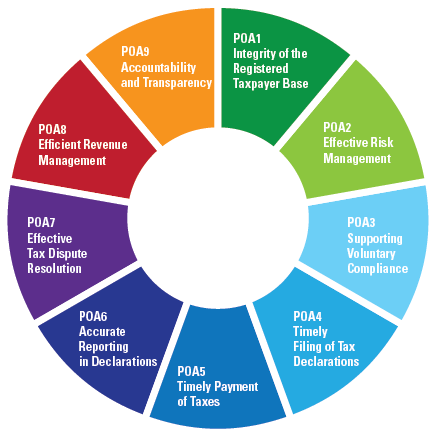
Please click on each POA section on image to view details
POA1: Integrity of the Registered Taxpayer Base
All businesses, individuals, and other entities that are required to register are included in a taxpayer registration database. Information held in the database is complete, accurate, and up-to-date.
P1-1-1: The adequacy of information held in respect of registered taxpayers and the extent to which the registration database supports effective interactions with taxpayers, tax intermediaries and other government agencies.
P1-1-2: The accuracy of information held in the registration database.
P1-2: The extent of initiatives to detect businesses and individuals who are required to register but fail to do so.
POA 2: Effective Risk Management
Risks to revenue and tax administration operations are identified and managed effectively.
P2-3-1: The extent of intelligence gathering and research to identify compliance risks in respect of the main tax obligations.
P2-3-2: The process used to assess, rank, and quantify taxpayer compliance risks.
P2-4: The degree to which the tax administration mitigates assessed risks to the tax system through a compliance improvement plan.
P2-5: The process used to monitor and evaluate the impact of compliance risk mitigation activities.
P2-6-1: The process used to identify, assess and mitigate operational risks.
P2-6-2: The process used to approve, monitor, test and evaluate the effectiveness of the business continuity program.
P2-7-1: The extent to which the tax administration has in place the capacity and structures to manage human capital risks.
P2-7-2: The degree to which the tax administration evaluates the status of human capital risks and related mitigation interventions.
POA3: Supporting and Facilitating Voluntary Compliance
Taxpayers have the necessary information and support to voluntarily comply at a reasonable cost to themselves.
P3-8-1: The range of information available to taxpayers to explain, in clear simple terms, what their obligations and entitlements are in respect of each core tax.
P3-8-2: The degree to which information is current in terms of the law and administrative policy.
P3-8-3: The availability to taxpayers of information and guidance from the tax administration.
P3-9-1: The time taken and quality of responses to taxpayer and tax intermediary requests for information.
P3-9-2: The design of service channel performance standards and the extent of regular management reporting of results.
P3-10: The extent of initiatives to reduce taxpayer compliance costs and facilitate compliance.
P3-11-1: The use and frequency of methods to obtain feedback from taxpayers on the standard and quality of services provided.
P3-11-2: The extent to which taxpayer input is taken into account in the design of administrative processes and products.
P3-12: The nature and scope of proactive initiatives undertaken to encourage accurate reporting.
POA4: Timely Filing of Tax Declarations
Taxpayers file tax declarations on time.
P4-13-1: The number of CIT declarations filed by the statutory due date as a percentage of the number of declarations expected from registered CIT taxpayers.
P4-13-2: The number of PIT declarations filed by the statutory due date as a percentage of the number of declarations expected from registered PIT taxpayers.
P4-13-3: The number of VAT declarations filed by the statutory due date as a percentage of the number of declarations expected from registered VAT taxpayers.
P4-13-4: The number of domestic excise tax declarations filed by the statutory due date as a percentage of the number of declarations expected from registered domestic excise taxpayers.
P4-13-5: The number of PAYE declarations filed by the statutory due date as a percentage of the number of declarations expected from registered PAYE taxpayers.
P4-14: Action taken to follow up non-filers.
P4-15: The extent to which tax declarations are filed electronically.
POA5: Timely Payment of Taxes
Taxpayers pay their taxes in full on time.
P5-16: The extent to which core taxes are paid electronically.
P5-17: The extent to which withholding at source and advance payment systems are used.
P5-18-1: The number of VAT payments made by the statutory due date in percent of the total number of payments due.
P5-18-2: The value of VAT payments made by the statutory due date in percent of the total value of VAT payments due.
P5-19-1: The value of total core tax arrears at fiscal year-end as a percentage of total core tax revenue collections for the fiscal year.
P5-19-2: The value of collectible core tax arrears at fiscal year-end as a percentage of total core tax revenue collections for the fiscal year.
P5-19-3: The value of core tax arrears more than 12 months’ old as a percentage of the value of all core tax arrears.
P5-20:The management and scope of arrears enforcement action.
POA6: Accurate Reporting in DeclarationsAccurate Reporting in Declarations
Taxpayers report complete and accurate information in their tax declarations.
P6-21-1: The nature and scope of the tax audit program in place to detect and deter inaccurate reporting.
P6-21-2: The extent to which the audit program is systematized around uniform practices.
P6-21-3: The degree to which the quality of taxpayer audits is monitored.
P6-21-4: The degree to which the tax administration monitors the performance and effectiveness of the taxpayer audit function.
P6-22: The extent of large-scale automated crosschecking to verify information reported in tax declarations.
P6-23-1: Scope and nature of the process to identify and plan responses to counter tax fraud.
P6-23-2: Effective implementation of the planned responses to counter tax fraud.
P6-24: The soundness of tax gap analysis method/s used by the tax administration to assess and monitor inaccurate reporting.
POA7: Effective Tax Dispute Resolution
The tax dispute resolution process is fair and independent, accessible to taxpayers, and effective in resolving disputed matters in a timely manner.
P7-25-1: The extent to which an appropriately graduated mechanism of administrative and judicial review is available to, and used by, taxpayers.
P7-25-2: Whether the administrative review mechanism is independent of the audit process.
P7-25-3: Whether information on the dispute process is published, and whether taxpayers are explicitly made aware of it.
P7-26-1: The time taken to complete administrative reviews.
P7-26-2: Stock of administrative reviews.
P7-27: The extent to which the tax administration responds to dispute outcomes.
POA8: Effective Performance and Efficient Revenue Management
Tax revenue collections are fully accounted for, monitored against expectations, and analyzed to inform government revenue forecasting. Legitimate tax refunds are paid promptly.
P8-28: The extent of the tax administration’s management of its performance.
P8-29: The extent of tax administration input to government tax revenue forecasting, estimating, and monitoring.
P8-30: Adequacy of the tax administration’s tax revenue accounting system.
POA9: Accountability and Transparency
The tax administration is transparent in the conduct of its activities and accountable to the government and community.
P9-32-1: Assurance provided by internal audit.
P9-32-2: Staff integrity assurance mechanisms.
P9-33-1: The extent of independent external oversight of the tax administration’s operations and financial performance.
P9-33-2: The investigation process for suspected wrongdoing or maladministration.
P9-34: The mechanism for monitoring public confidence in the tax administration.
P9-35-1: The extent to which the financial and operational performance of the tax administration is made public, and the timeliness of publication.
P9-35-2: The extent to which the tax administration’s future directions and plans are made public, and the timeliness of publication.
TADAT Assessment
TADAT Assessment Trends
















TADAT Secretariat Team
The TADAT Secretariat comprises a Head, three technical experts, a project analyst, and a division coordinator. Under the guidance of the GPFP, and in line with the Program Document, the TADAT Secretariat plans, implements, and monitors the TADAT program.





TADAT Outreach
Outreach




TADAT News & Events
Latest News & Updates
.png)